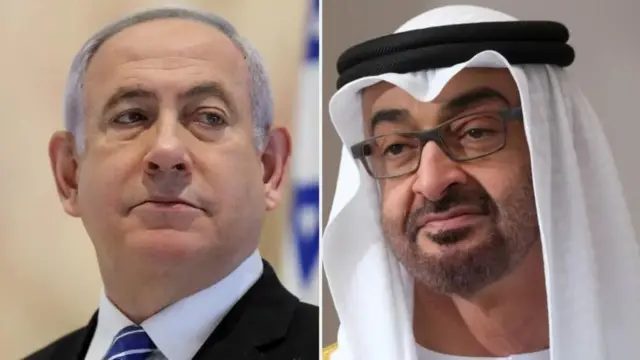
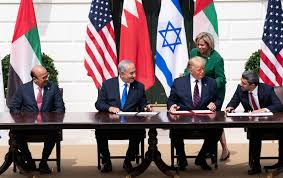
The Abraham Accords, signed in 2020, represent a major milestone in the history of diplomatic relations in the Middle East, marking a significant shift in regional alliances and international relations. Negotiated under US auspices and with active participation from Donald Trump's administration, these accords enabled Israel to normalise relations with several Arab countries: the United Arab Emirates (UAE), Bahrain, and more recently Morocco and Sudan. This normalisation of relations has had profound consequences for politics, security and economic interests across the region. But what do we really know about these accords, and what impact have they had on the Middle East?
For more information: /
1. Historical context of the Abraham Accords
Relations between Israel and Arab countries have long been marked by hostility and tension, primarily because of the Israeli-Palestinian conflict, which lies at the heart of Middle Eastern disputes. Hostility intensified after Israel's creation in 1948, notably through wars in 1948, 1956, 1967 and 1973, as well as decades of violence and failed negotiations to reach a peaceful solution.
The first real turning point came in 1979 with the signing of the Camp David Accords, which allowed Egypt, led by Anwar Sadat, to sign a peace treaty with Israel. It was a bold move, but an isolated one in a context where most Arab countries remained firmly opposed to any form of recognition of Israel. Egypt paid a heavy price for its action: it was excluded from the Arab League for several years.
Over the years, Arab countries continued to support the Palestinian cause while calling for the creation of an independent Palestinian state as a precondition for any normalisation with Israel. Yet some countries gradually came to see the need to shift their position in light of new geopolitical realities.
2. The signatories and terms of the accords
The Abraham Accords were signed in 2020 between Israel and three Arab countries: the United Arab Emirates (UAE), Bahrain, and later Morocco and Sudan, which announced their intention to normalise relations with Israel. These accords were facilitated by the United States under the Trump administration.
The terms of the accords vary, but they focus mainly on normalising diplomatic relations, economic cooperation and security. The signatories committed to exchanging ambassadors, establishing trade and tourism relations, and cooperating in strategic areas such as technology, defence and counter-terrorism.
- The United Arab Emirates were the first to sign an official accord with Israel, marking the end of a 72-year boycott.
- Bahrain, led by a Sunni monarchy close to the UAE, followed suit, supporting peace initiatives and normalising relations with Israel.
- Morocco also concluded an accord, and saw Israel and the United States recognise Moroccan sovereignty over Western Sahara.
- Sudan, which had recently begun a democratic transition process after decades of dictatorship, also signed an accord, despite internal concerns linked to its past hostility towards Israel.
A key feature of these accords is that they did not make resolving the Israeli-Palestinian conflict a precondition, unlike what was often required in previous peace initiatives, such as the 2002 Arab Peace Plan. The accords were therefore seen by some as a break with the historical Arab position on Palestinian rights.
3. The political and diplomatic impact of the Abraham Accords
A shift in regional politics
The immediate impact of the Abraham Accords was a radical shift in how Arab countries approach the Israeli question. The accords signalled a thaw in diplomatic relations, particularly for Gulf countries. Until then, most Arab countries had refused to recognise Israel until a solution to the Israeli-Palestinian conflict was found.
With the Abraham Accords, Israel succeeded in establishing diplomatic relations with countries that had previously viewed its existence as an existential threat. This changed regional political balances and led to more visible cooperation between Israel and certain Arab countries.
The United States, under Donald Trump's presidency, used these accords to strengthen its influence in the region and counter Iran's growing influence, a key Middle Eastern player, particularly because of its role in supporting terrorist groups and conflicts in Syria, Lebanon and Yemen.
Iran's reasserted power
Iran's role, particularly in its relations with Hezbollah in Lebanon, Syria and Yemen, was a major concern in the Abraham Accords. Iran, which supports groups like Hamas and Palestinian Islamic Jihad, views this normalisation with disfavour, and its leaders have denounced these accords as a betrayal of the Palestinian cause.
Yet this normalisation has also forced Iran to adjust its strategies and intensify its influence over other groups across the region. The rebalancing of Gulf alliances, reinforced by Israel, has therefore heightened tensions with Tehran.
4. Economic and security consequences
A strategic and economic rapprochement
The Abraham Accords have had a profound impact on economic relations between Israel and its new Arab partners. The Emirates, for example, signed bilateral agreements with Israel in strategic sectors such as technology, artificial intelligence, agriculture and renewable energy. In return, Israel gains access to an important market in the region, which boosts its own economy.
Defence partnerships have also been strengthened. Israel has developed stronger ties with the armed forces of the signatory countries, and the Emirates in particular have purchased Israeli military equipment. These accords have allowed Israel to strengthen its role as a military and technological power in the region.
Securing trade and diplomatic routes
Another important consequence has been the securing of trade and energy routes in the Gulf region. Growing cooperation between Israel and its neighbours has helped ensure greater stability for businesses operating in the region, particularly in energy and maritime transport.
5. Challenges for the Palestinian cause
Palestine's more isolated position
One of the most controversial effects of the Abraham Accords has been a sense of abandonment among Palestinians. These accords had the effect of further marginalising the Palestinian cause by placing it outside the central framework of Middle Eastern diplomatic relations. While Arab countries had historically supported Palestinians in their demands for an independent state, normalisation with Israel was seen by many as a repudiation of the traditional Arab position on Palestinian rights.
Some observers saw in these accords an opportunity to reassess the Israeli-Palestinian peace process, but others saw it as a signal of Arab regimes abandoning the Palestinian struggle.
6. Impact on internal relations within Arab countries and regional tensions
The Abraham Accords have generated varied reactions within the signatory Arab countries themselves, as well as among other states in the region. While some governments saw these accords as an important diplomatic and strategic advance, others viewed this normalisation as a sign of betrayal of the Palestinian cause and submission to Western interests, particularly those of the United States.
Internal impact in signatory countries
In signatory countries such as the United Arab Emirates, Bahrain and Morocco, the internal reaction was mixed between government support and popular opposition. For the authorities, these accords opened new economic, diplomatic and security perspectives. The Emirates, for example, sought to position itself as a key player in regional and international politics by establishing relations with Israel, a strategic ally of the United States. This normalisation also allowed the UAE to strengthen its position as an economic and technological leader in the Middle East, particularly in innovation in sectors such as artificial intelligence and cutting-edge technology.
However, this favourable position was not shared by all segments of society. Indeed, a large part of the Arab population, particularly young people, remains deeply attached to Palestinian solidarity. In the streets of some Arab capitals, such as Abu Dhabi or Manama, protests took place to express opposition to the normalisation of relations with Israel. Although these protests were largely controlled by the authorities, they highlighted the gap between leaders and part of the population. The accord thus revealed a complex dynamic: on one side, a pragmatic strategy and on the other, ideological opposition rooted in traditional Arab solidarity with Palestine.
For Morocco, the situation is even more delicate. While normalisation of relations with Israel strengthened its diplomatic influence and benefited from US support on the Western Sahara issue, part of the Moroccan population, particularly within left-wing and Islamist political parties, denounced this move as a compromise of the kingdom's historical position of support for the Palestinian cause. The kingdom, however, highlighted the economic benefits, particularly in tourism and investment, to justify this accord.
Impact on the Arab world and pressure on other regional countries
One of the most interesting side effects of the Abraham Accords has been the pressure exerted on other Arab countries that have not signed these accords. Leaders of countries such as Saudi Arabia, Egypt and Jordan have had to navigate a delicate diplomatic environment. In particular, Saudi Arabia, as a regional leader and protector of Islam's holy sites, has closely observed developments, seeking to maintain a balance between Palestinian solidarity and its own strategic interests.
Saudi Arabia, while not signing a formal accord, has adopted a more flexible position, and some analysts have suggested that the kingdom could, in the future, normalise relations with Israel, especially if a lasting peace framework is found between Israel and the Palestinians. Saudi Arabia's "open hand" policy towards Israel has been evident in the possibility of Israeli overflights of its territory and discreet diplomatic contacts.
That said, the Saudi kingdom must account for opposition from public opinion, which is largely pro-Palestinian, and the positions of certain Islamist groups that oppose any form of rapprochement with Israel. The process of normalisation with Israel therefore remains a sensitive issue that requires careful management of internal relations.
In countries such as Jordan and Egypt, which have already signed peace accords with Israel (in 1994 and 1979 respectively), the Abraham Accords have revived debate about the benefits and drawbacks of normalisation with Israel. While these countries have largely opted for a "cold peace" policy, focusing mainly on security and stability in their relations with Israel, the emergence of new accords has nonetheless reignited internal tensions over the Palestinian question. Many Jordanian and Egyptian citizens view Israel as an illegitimate occupier of Palestinian territories, and any new cooperation with the Jewish state is viewed with scepticism.
Iran's role and growing tensions in the region
Another important dimension of the Abraham Accords is their impact on Iran. For decades, Tehran has positioned itself as the main supporter of the Palestinian cause, notably through its backing of militant groups such as Hamas and Palestinian Islamic Jihad. Iran views the normalisation of relations between Israel and certain Arab countries as an attempt to isolate and marginalise its influence in the region.
Iran, which also supports Shia groups such as Hezbollah in Lebanon and opposes US influence and its allies, has reacted strongly by condemning these accords. For Iran, these accords are not merely diplomatic normalisation, but a strengthening of the Sunni front against it, thereby exacerbating sectarian rivalry in the region.
The Abraham Accords have thus contributed to deepening Iran's isolation, while pushing some of its allies in the region, such as Syria and Iraq, to reconsider their relations with Israel. Iran has in fact intensified its military activities in strategic areas such as Syria and Yemen to counter the growing influence of Gulf countries and Israel.
Prospects for lasting peace in the Middle East
Another important aspect of the Abraham Accords concerns their impact on the Israeli-Palestinian peace process. The absence of a precondition linked to the creation of a Palestinian state has drawn sharp criticism, as it is seen by many observers as a weakening of the Palestinian cause. Palestinian leaders, notably from the Palestinian Authority, have expressed their dissatisfaction, noting that these accords risked consolidating Israeli occupation of Palestinian territories without any tangible concessions for Palestinians.
However, some analysts believe these accords could offer a new opportunity for peace, by encouraging Israel to seek more equitable solutions for Palestinians, especially if normalisation with Arab countries shifts the balance of power in the region. The hope, for some, is that increased pressure from Arab countries on Israel, because of their bilateral cooperation, could favour a more balanced solution to the Palestinian question.
Conclusion on the Abraham Accords
Ultimately, the Abraham Accords mark an important geopolitical transformation in the Middle East. Their impact remains profound and multidimensional, affecting not only diplomatic and economic relations, but also the internal dynamics of Arab countries and regional tensions. While these accords have strengthened the positions of Israel and the signatory Arab countries on the international stage, they have also amplified internal divisions and regional tensions, particularly with Iran and the Palestinians. The coming years will be crucial in assessing the results of this normalisation and its long-term impact on peace and stability in the region.
External links